

A utility-scale solar array is designed for a 25-year service life. In practice, the part that limits that lifespan is rarely the panel or the inverter — it is the joint between the aluminium mounting rail and the steel substructure underneath it, and specifically, the screw that holds the two together.
Aluminium rails (typically 6005-T5 or 6063-T5) are fixed to galvanised steel purlins or cold-formed steel framing. Put two dissimilar metals in electrical contact with rainwater or condensation between them, and you get a galvanic cell: aluminium is the more active metal, so it corrodes to protect the steel fastener. The first sign is a white powdery deposit around the fastener head; left alone, it progresses to pitting and then to an oversized, oval hole. Once the hole is bigger than the fastener head, the rail can shift under wind load.
Why a single-material screw cannot solve this
A fastener hard enough to self-drill through steel purlins has to be either carbon steel or martensitic stainless (SS410) — and both sit far enough from aluminium on the galvanic series to drive the corrosion described above. A screw with better galvanic compatibility with aluminium (SS304 or SS316) is not hard enough to self-drill structural steel on its own.
The bi-metal answer
| Component | Material | Role |
|---|---|---|
| Body & shank | SS304 or SS316 (austenitic) | Galvanic compatibility with the aluminium rail |
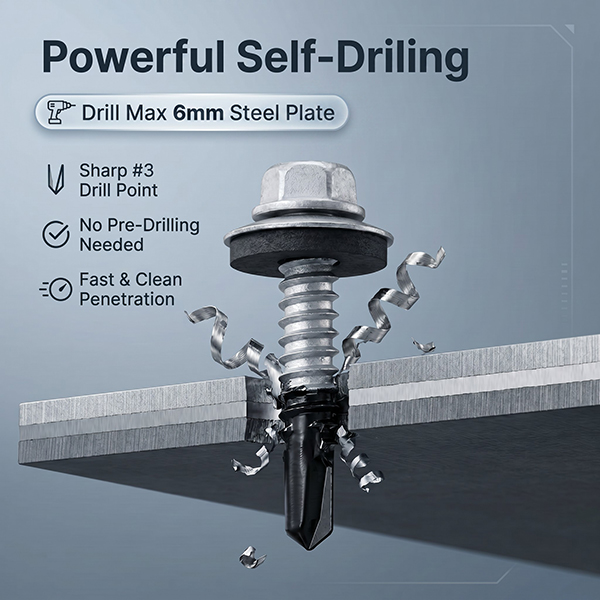
| Drill point | SCM435 alloy steel, HRC 50–55 | Drills 2.0–3.0mm steel purlin at carbon-steel speed |
The stainless body keeps the potential difference against the aluminium low enough that the rail stays sound for the design life of the array; the heat-treated alloy point supplies the hardness the stainless body cannot.
Three specification details that matter
- Double thread. The first thread start engages the aluminium rail, the second engages the steel purlin, giving a dual-locking fix that resists the vibration loosening caused by wind-induced panel flutter.
- SS304+EPDM bonded washer. A washer chemically fused to a stainless backing seals permanently where a loose rubber washer would perish or slip during installation.
- Coated drill point. The SCM435 tip is still carbon-alloy steel, so it needs a Ruspert or equivalent coating to stop rust starting at the tip during installation or from trapped condensation.
Worth the premium
Bi-metal fasteners cost more up front than coated carbon steel. On a live array, replacing corroded fasteners means decommissioning strings, arranging access, and in many cases voiding the racking or panel warranty for having used an incompatible fastener in the first place. Specifying bi-metal at the outset is closer to an insurance decision than a materials decision: the smallest component in the system should not be the reason the largest investment fails.
TSR Europe supplies bi-metal self-drilling screws with SS304/316 bodies and SCM435 drill points, built for solar, roofing and facade fixing across aluminium-to-steel joints.
See the Bi-metal range →Technical background adapted from TGR/Tsingri manufacturing specifications for the European market.