

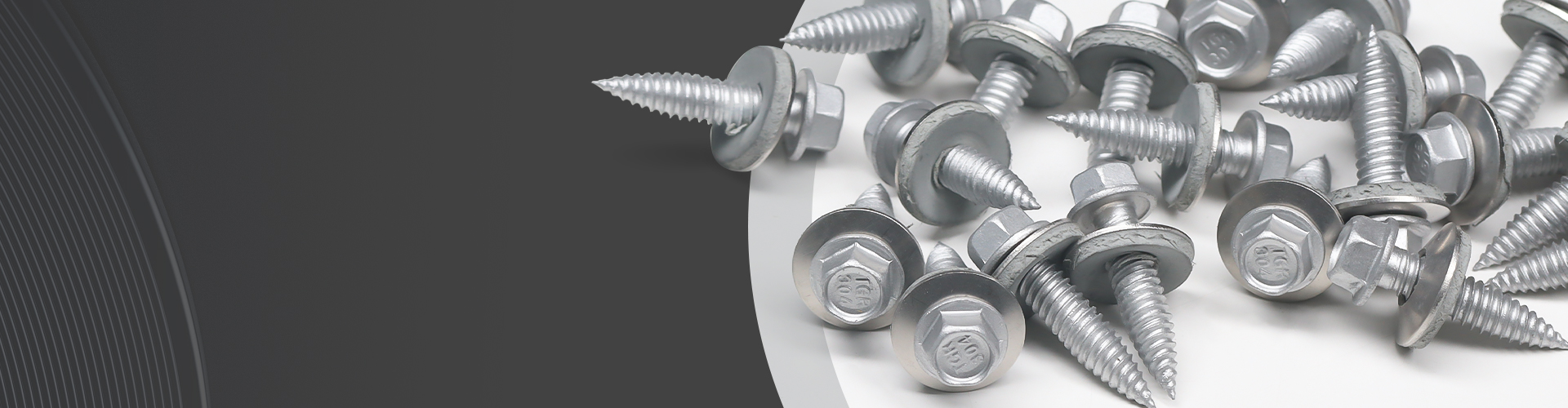
A roofing fastener that fails first shows up as a leak — a functional problem, usually found before it does much damage. A cladding fastener that fails first shows up as a rust streak on the facade at eye level — a visual problem that a building owner notices immediately. Cladding is driven at angles rather than straight down, is visible rather than hidden under laps, and has far less tolerance for a downgraded surface treatment. All of that changes how the fastener should be specified.
Hex washer head or pan head: not interchangeable
The two most common head types are not alternatives for the same job — each is built for a different fixing point.
Hex washer head with EPDM washer
The standard for exposed fixing of profiled metal cladding. The hex drive delivers higher torque than Phillips or Torx without cam-out, which matters because the bonded EPDM washer needs to be compressed to precisely the right degree: under-driven and it does not seal, over-driven and the washer deforms and the seal fails. A hex-indented variant, with a recessed underside, spreads that compression more evenly on curved or profiled panel faces.
Phillips pan head
A low-profile, flat-underside head used for structure fixing to heavy steel — backing rails, brackets, internal framing — where a flush head is wanted and the fixing is not weather-exposed. It is not the right choice for an exposed cladding face: without an EPDM washer it does not form a weatherpoint, and if it must be used somewhere visible it needs a separate EPDM-faced backing washer.
Matching drill point to substrate
| Point | Substrate range | Typical use |
|---|---|---|
| #3 | 0.8–7.0mm steel | Standard cladding to secondary framing, purlins, Z-girt |
| #5 | 6.0–12.5mm steel | Heavy structure fixing, backing rails to steel columns/beams |
Fine thread (higher engagement per length) generally outperforms coarse thread once the steel substrate is over 2.0mm; coarse thread remains standard for light-gauge steel, timber and valley fixing.
Coating: match to exposure, not just to spec sheet minimums
Zinc plating on carbon steel typically fails within 3–5 years outdoors. A multi-layer Ruspert coating (zinc flake + binder + sealant) is a different order of protection, and is the sensible minimum for any externally exposed cladding fastener — zinc plating should be reserved for internal or sheltered fixings only. For facades within a kilometre of the coast, step up to the higher Ruspert grade or specify SS410; in direct salt-spray or marine exposure, specify stainless or bi-metal even where the base substrate is ordinary carbon steel, because the coating alone will not carry the design life.
Where the fastener head will be visible, colour-matched finishes are available against standard RAL references — confirm the code against the panel spec and allow extra lead time, since colour-matched fasteners are made to order.
Before you finalise the spec
- Panel type and whether the fastener head will be visible on the finished facade
- Substrate and thickness — decides #3 vs #5 point and fine vs coarse thread
- Exposure zone — inland, coastal or marine
- Coating: Ruspert grade, SS410 or bi-metal
- Washer requirement for weather sealing at exposed heads
- Driver compatibility with the installation crew’s tooling
TSR Europe supplies hex washer head and Phillips pan head self-drilling screws for cladding and structure fixing, in #3 and #5 drill points.
See the Metal Construction Screws range →Technical background adapted from TGR/Tsingri manufacturing specifications for the European market.