

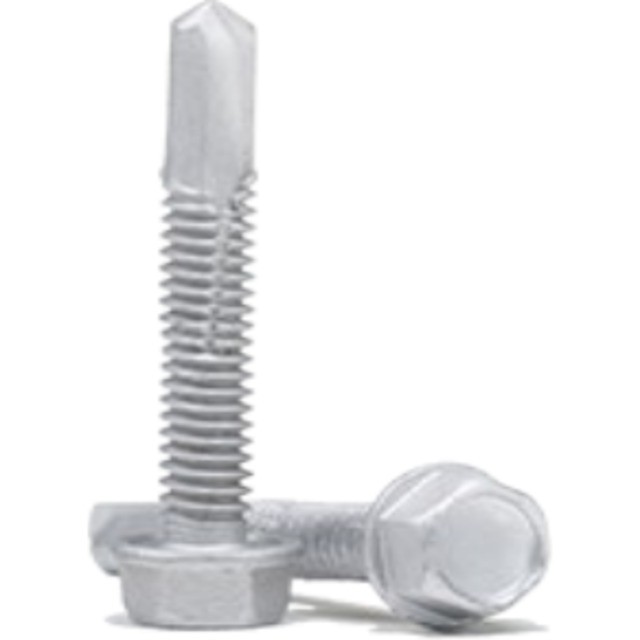
A self-drilling screw that is under-specified for its drill point will strip or snap before it seats; one that is over-specified wastes drilling time and torque for no benefit. Matching drill point, thread type and minimum length to gauge is a basic but often overlooked step in specifying stainless round washer head self-drilling screws.
Matching drill point to gauge
As a general rule: a #2 point is used on gauges up to and including 6#, a #3 point on 8# and above, and a #5 point is reserved for the heavier 12# and 14# gauges. For 8# and 10# screws shorter than 1/2″, use the #2 point; longer 10# and above should use the #3 point.
| Gauge | Drill point | Minimum length |
|---|---|---|
| 6# / 8# | #2 | 13mm |
| 6# / 8# | #3 | 16mm |
| 10# | #2 | 16mm |
| 10# | #3 | 19mm |
| 12# | #3 | 22mm |
| 14# | #3 | 25mm |
Going below these minimum lengths for a given drill point risks the point burning out before it clears the substrate, especially on thicker steel.
Full thread or half thread
Length also decides thread coverage on stainless round washer head self-drilling screws: below 1-1/2″ the screw is fully threaded; above 1-1/2″ it runs half thread, with a fixed 1-1/2″ of thread length regardless of overall screw length.
Head types
Three head types cover most applications: hexagonal washer head (HW) for maximum drive torque and a large bearing surface, pan head (P) for a lower profile where clearance is tight, and countersunk head (F) where the fastener needs to sit flush with the material surface.
BSD vs CSD thread
The two common thread families are not interchangeable: BSD is an AB-type self-tapping thread, cutting its own mating thread as it drives; CSD is a mechanical (machine) thread, intended to engage a pre-formed or pre-tapped thread. Specifying the wrong type for the substrate is a common cause of stripped fixings on site.
TSR Europe supplies stainless round washer head self-drilling screws across the #2, #3 and #5 drill point range, in HW, pan and countersunk heads.
See the Metal Construction Screws range →Technical parameters adapted from TGR/Tsingri manufacturing specifications for the European market.