
SS410 vs SS304 vs SS316: Choosing the Right Stainless Screw (and Debunking the Magnet Myth)
Three stainless grades come up constantly in fastener specifications — SS410, SS304, SS316 — and they are not interchangeable, even though all three are called “stainless”. The difference that matters most is not corrosion resistance, it is whether the screw can self-drill at all.
Why SS410 self-drills and SS304/316 do not
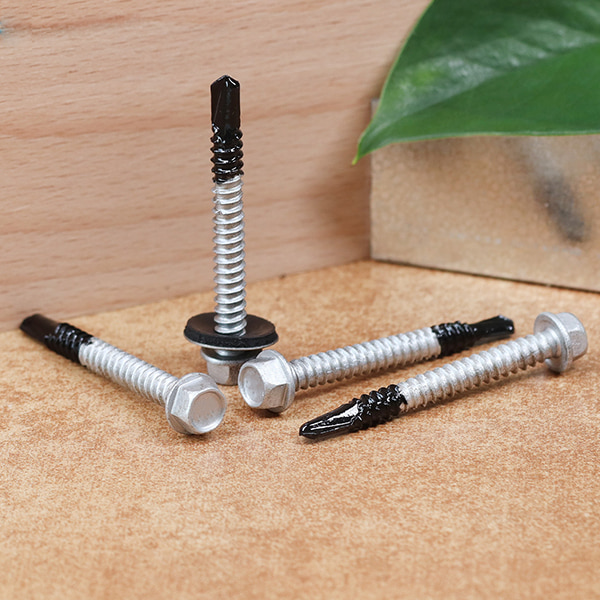
SS410 is martensitic stainless: its carbon content allows it to be quenched and tempered to HRC 40–50, the hardness a self-drilling point needs to cut through structural steel. SS304 and SS316 are austenitic — they cannot be hardened by heat treatment, so a solid screw made from either simply is not hard enough to self-drill. That is the whole reason bi-metal fasteners exist: a hardened alloy point does the drilling, an austenitic body provides the corrosion resistance the point cannot.
The magnet test does not work
Magnetism is a property of crystal structure, not quality: SS410 is magnetic because it is martensitic, SS304/316 are non-magnetic because they are austenitic. A magnetic screw is not necessarily inferior, and a non-magnetic one is not necessarily genuine SS316 — some manufacturers use SS304 with a passivation process that reduces surface magnetism. The only reliable verification is a Mill Test Certificate, batch marking, or an independent salt-spray (NSS) lab report.
Material comparison
| Grade | Self-drills | Magnetic | Corrosion resistance | Typical role |
|---|---|---|---|---|
| SS410 | Yes (HRC 40–50) | Yes | Good, can surface-stain in coastal air | Solid self-drilling screw |
| SS304 | No | No | Excellent | Body/shank of bi-metal screws |
| SS316 | No | No | Superior — resists chloride pitting | Body/shank of bi-metal screws, marine exposure |
Which one for which project
- Dry inland, low corrosivity: solid SS410 — the most cost-effective option with adequate protection.
- Standard coastal / high humidity: SS304 bi-metal — hardened point for drilling, SS304 body for rust resistance.
- Marine or heavy chemical exposure: SS316 bi-metal — the molybdenum content is what stops chloride pitting in these conditions.
As a rule of thumb: SS410 alone is fine away from the coast; anywhere within reach of sea spray, specify a bi-metal fastener rather than a solid stainless screw.
TSR Europe supplies SS410 self-drilling screws and SS304/316 bi-metal fasteners for coastal and marine specification.
See the Stainless Steel range → See the Bi-metal range →Technical background adapted from TGR/Tsingri manufacturing specifications for the European market.